Save
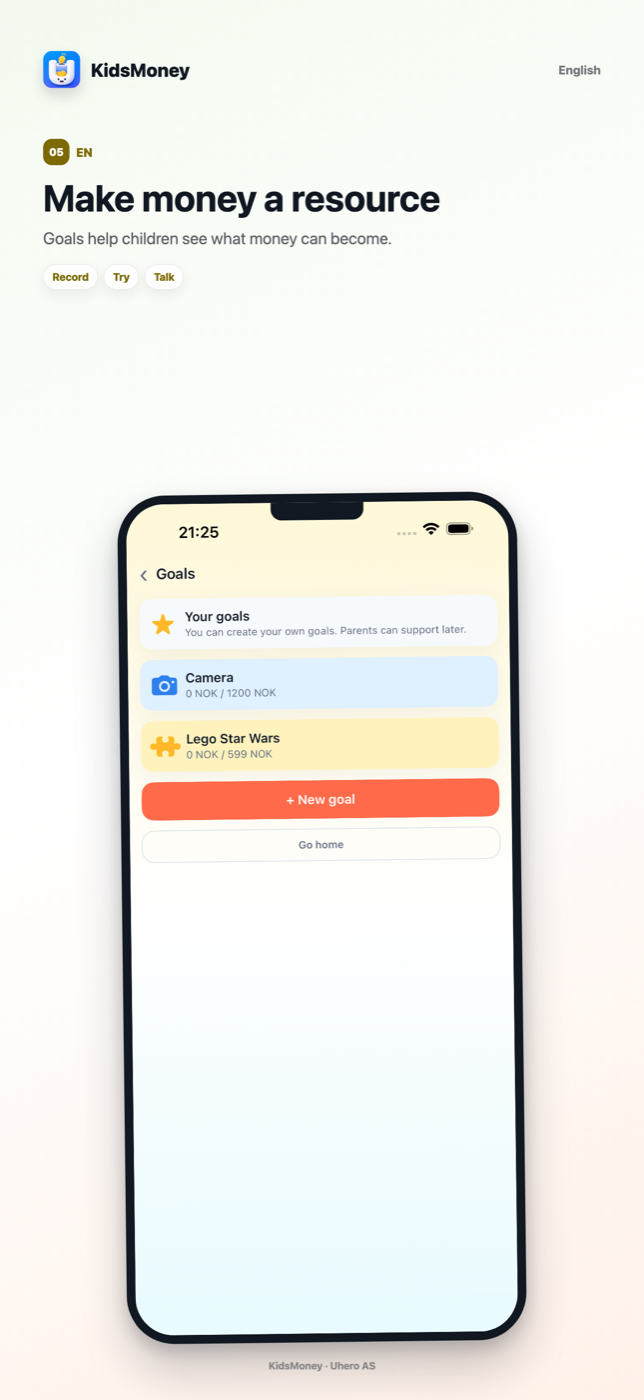
Make a goal visible so waiting feels like a plan, not just saying no.
 KidsMoney
Allowance-led money talks
KidsMoney gives parents and children a shared family record for pocket money: what came in, what was spent, what to save, and how to plan the next choice. The launch app does not connect to banks, cards, or payment accounts.
It is a learning tool, not a bank card. Parents guide the conversation while children practise with money that feels like their own.
The principle
KidsMoney turns saving, spending, and budgeting into a small weekly conversation. Parents and children see the same family record, not a hidden dashboard.
Who it is for
Built for children around 6-12, especially 7-10, who are ready to practise small allowance choices with a parent nearby.
Make a goal visible so waiting feels like a plan, not just saying no.
Record what changed after a choice, without turning every purchase into judgment.
Help the child see what is available now, what is planned, and what has to wait.
Start from shared facts while keeping the product away from hidden surveillance.
Free printable resource
A simple four-page paper kit for families figuring out allowance, cash, cards, goals, and money talks. Use it before the app, alongside the app, or instead of the app while your family finds its rhythm.
Research basis
KidsMoney does not claim to be scientifically proven. It is designed around learning mechanisms supported by youth financial capability research: repeated practice, visible choices, goal setting and parent-child money talk.
Children need small, safe decisions they can repeat and reflect on.
Parent-child money conversations are part of financial socialization when they are concrete and age-appropriate.
Seeing choices and goals helps money become a resource for planning, not just a number.
The careful claim: KidsMoney is designed around evidence-backed mechanisms. Stronger outcome claims require KidsMoney's own user study.
The method
The child can see money, goals and recent choices without needing a spreadsheet or bank account.
Received money, used money, moved money toward a goal. Simple words make money less abstract.
Parents get a calmer starting point for conversation, not a control panel for surveillance.
Money becomes a resource for plans and tradeoffs, not only a balance to protect.
Parent questions
KidsMoney starts from real parent questions: how much freedom, what privacy, how to discuss spending, and how to teach saving and budgeting without turning allowance into control.
The learning loop
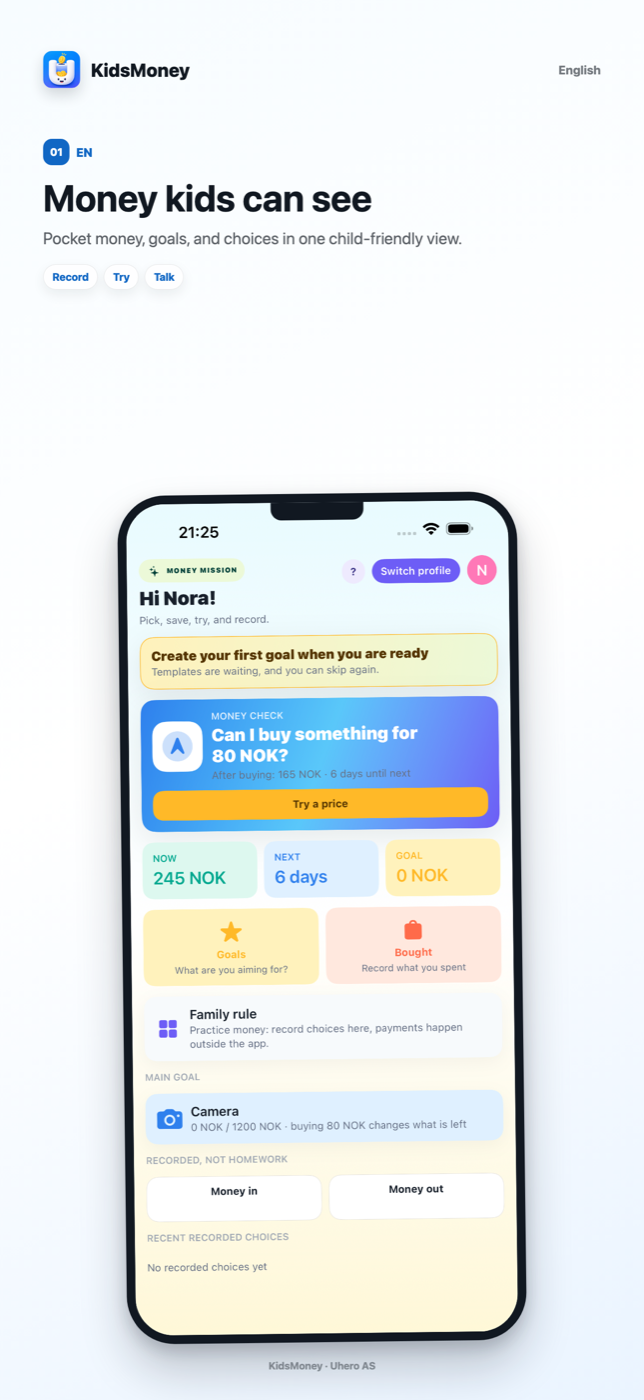
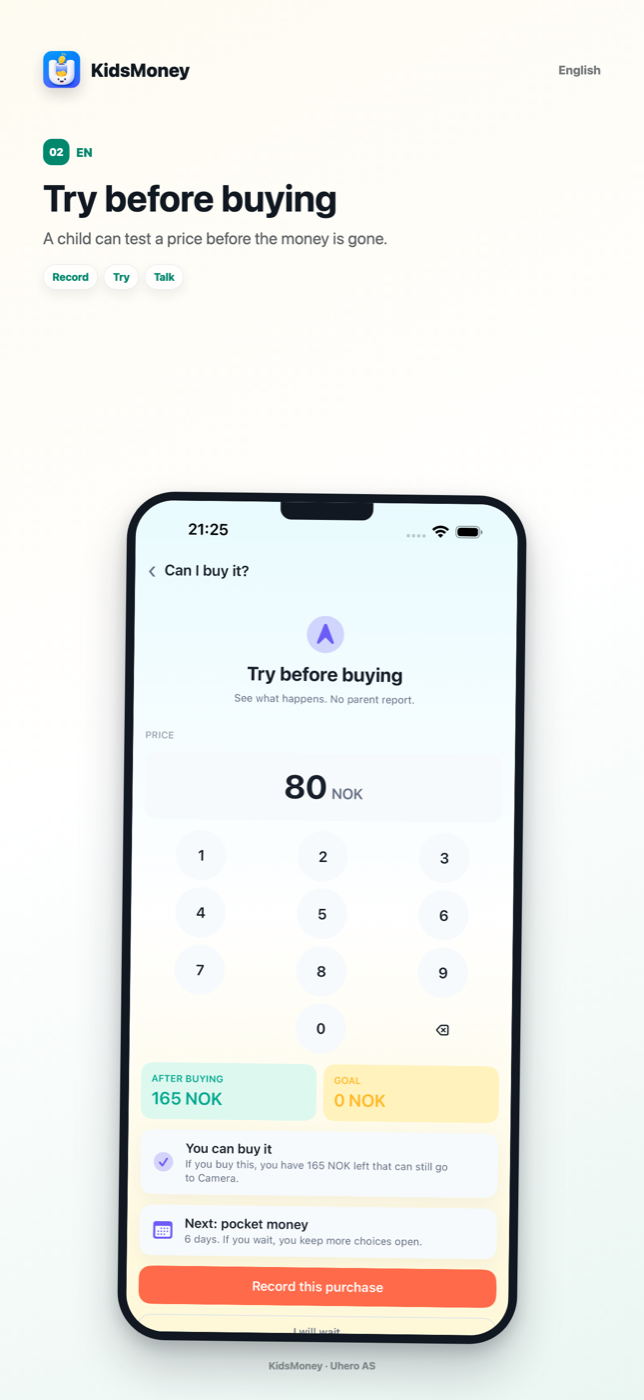
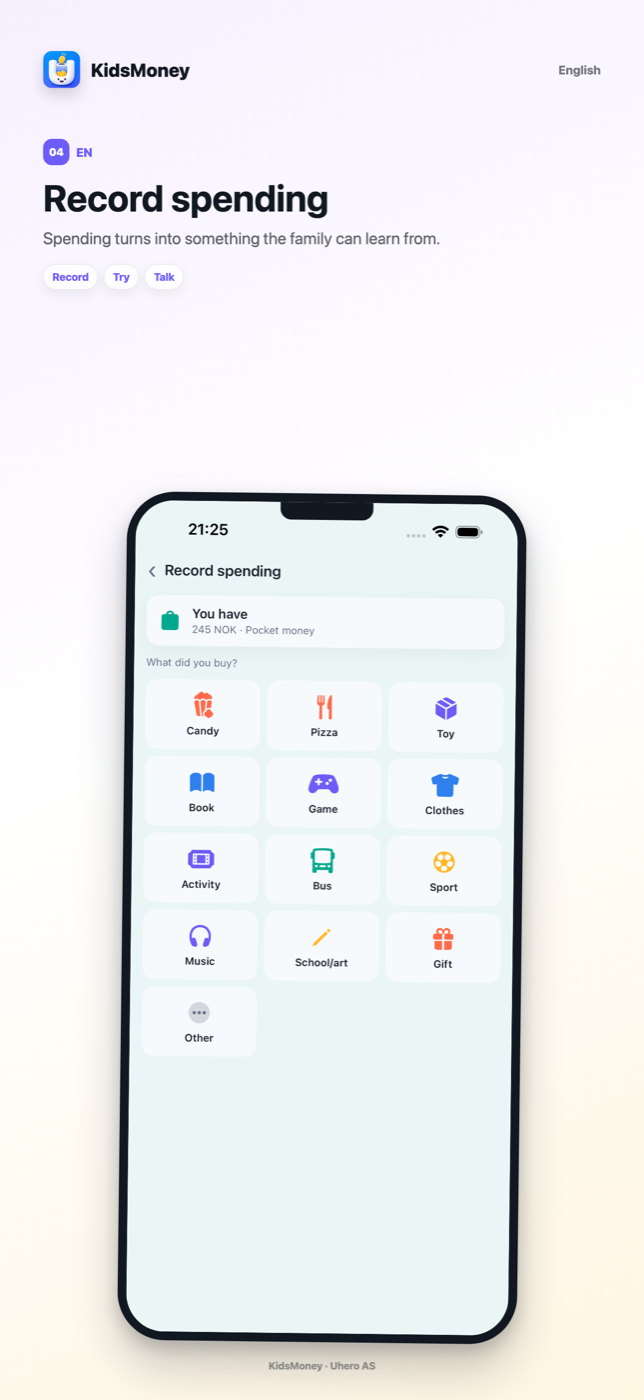
The screens follow the child's own money: what they have, what a choice costs, what changes after spending, and how a goal turns waiting into a plan.
Current native app screens shown. KidsMoney records and reminds; real payment still happens outside the app.
Not just saving
KidsMoney keeps pocket money visible so children can practise planning, spending, saving, and tradeoffs with a parent beside them.
KidsMoney vision
KidsMoney turns pocket money into a safe practice space for receiving, spending, saving, planning and talking about tradeoffs with a parent.
Straight answers
Cash is still useful. KidsMoney is for families who also want one shared record when money comes from allowance, gifts, digital purchases or saved goals.
A spreadsheet can work for parents who maintain it. KidsMoney is for families who want the child to open the same record, see their own money and goals, and understand what they are looking at.
No. KidsMoney records and reminds. Real payment, transfer and banking happen outside the app.
KidsMoney is not a monitoring app. The parent view shows the family's shared records, the same records the child can also see. There is no hidden log, location tracking or parent alert feed.
KidsMoney is built for children around 6-12, especially 7-10, who can count simple amounts and are ready to practise small allowance choices with a parent nearby.
The launch plan is a paid app, not a banking or card subscription. The App Store will show the final local price.
Free download
Leave your email to show the printable PDF link. We will also send one note when KidsMoney is ready for the App Store.